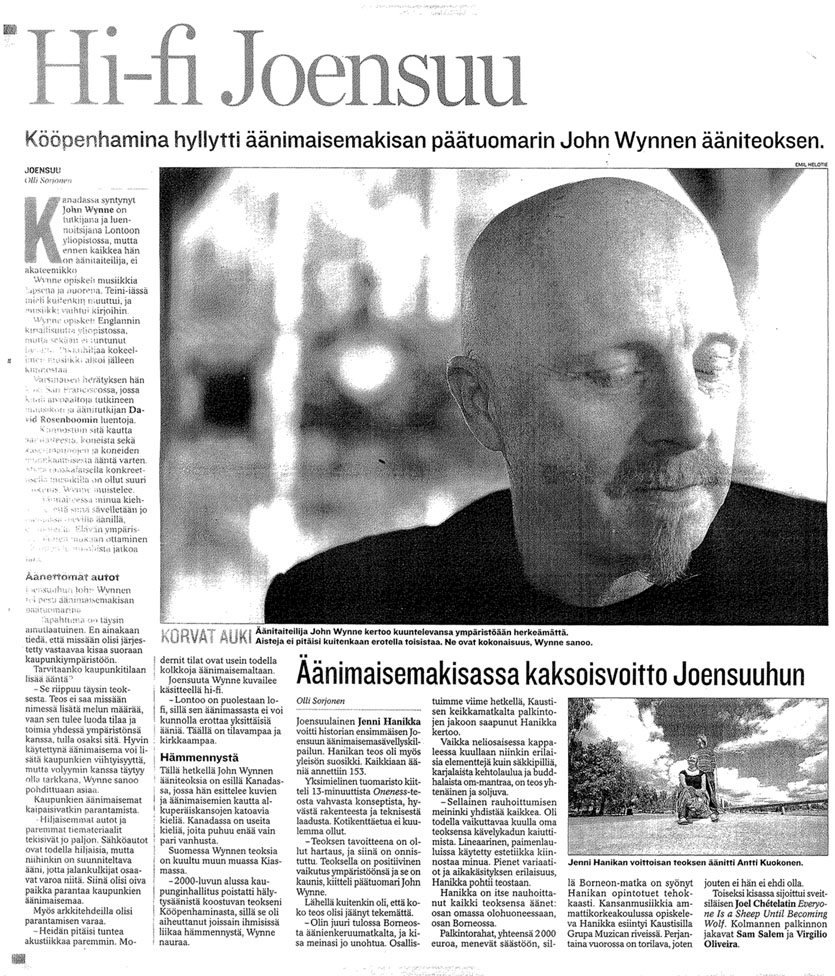
Translation
HI-FI JOENSUU
Ears Open: A sound work by the head of the jury in Joensuu Soundscape Composition Contest, John Wynne, was banned in Copenhagen
Sound artist John Wynne describes himself as being in a state of constant environmental listening. However, he is quick to point out that the senses should not be compartmentalised but rather should be seen as a wholeness.
Born in Canada and now based in London, Wynne works as a researcher and lecturer, though he considers himself primarily an artist, rather than an academic. His career path was not a straight line: he initially studied music before pivoting to English literature as a teenager. Finding that neither quite fit, he gradually found his way back to experimental music.
His “awakening” occurred in San Francisco, sparked by the lectures of musician and researcher David Rosenboom, whose work explored making music from brainwaves. “Through that experience, I became interested in sound art—in the physical manipulation of tape and the hacking of devices to create sound. Musique concrète also made a profound impression,” Wynne recalls. “For me, the fascination of sound art lies in the approach: working with ‘found’ sounds rather than composed notes.” Integrating the living atmosphere into his creative process was a natural evolution.
Silent CitiesWynne travelled to Joensuu to chair the jury for a unique soundscape composition contest. “This event is truly one of a kind. I’m not aware of any other competition where works are integrated so directly into the urban environment.”
When asked if urban spaces really need more noise, Wynne ponders the question before responding. “That depends entirely on the work. We weren’t looking for pieces that simply added to the existing noise, but rather those capable of leaving space for—and collaborating with—the environment. Used thoughtfully, a public sound installation can make the urban landscape far more engaging, provided meticulous attention is paid to loudness.”
What would truly improve the city’s acoustic life? “Quieter cars and better road materials would make a vast difference. Electric cars are almost silent, but they have to have sound added to alert pedestrians. Used imaginatively, this could present a great opportunity to enhance the urban soundscape.”
He also points to the built environment. “Architects should pay far more attention to acoustics than they usually do. Public spaces are often disastrous in terms of sound and listening.”
Regarding Joensuu itself, Wynne describes it as a ‘hi-fi’ environment. “London, by contrast, is almost always ‘lo-fi’; individual sounds are swallowed by a dense mass of noise. In smaller cities like Joensuu, the soundscape is more spacious, transparent, and bright.”
ConfusionCurrently, Wynne’s work is on display in Vancouver, where he uses image and sound in an installation about one of Canada’s endangered indigenous languages. His work has also been exhibited internationally, including at Kiasma in Helsinki.
Recalling the more controversial side of public sound art, he mentions a project from the early 2000s. “The city of Copenhagen actually banned a piece of mine that used alarm sounds in the Town Hall Square,” Wynne laughs. “They claimed it frightened and confused the public.”
Double Win to Joensuu in the Soundscape Contest
Jenni Hanikka, a local artist from Joensuu, has been named the winner of the inaugural Joensuu Soundscape Composition Contest. Her work, Oneness, was also a clear favourite with the public, securing first place in the audience vote out of 153 ballots cast.
The jury was unanimous in its praise for the 13-minute composition, citing its strong conceptual foundation, refined structure, and high technical quality. The panel noted that although Hanikka is local, there was no “home-field advantage” involved; the work stood entirely on its own merits.
“The objective of the piece was tranquillity, and that was beautifully achieved,” noted John Wynne, head of the jury. “The work has a genuinely positive effect on its surroundings; it is quite simply a beautiful piece of art.”
For Hanikka, the win was a close call. “I had only just returned from a field-recording trip in Borneo, and the competition had almost slipped my mind. We managed to submit it at the very last minute,” she explained, arriving in Joensuu directly from a performance at the Kaustinen Folk Music Festival.
Oneness is a four-part work that weaves together seemingly disparate elements—including bagpipes, a Karelian lullaby, and a Buddhist Om mantra—into a coherent and fluid whole.
“A sense of calm unites the various parts,” Hanikka reflected. “It was a profound experience to hear my own work broadcast through the sound system in the pedestrian zone. I’ve long been interested in the linear aesthetic of shepherd songs—the subtle variations and the unique perception of time they evoke.”
Hanikka recorded all the source material herself, ranging from sounds captured in her own living room to field recordings from Borneo. The €2000 prize money will go towards savings, helping to offset the cost of her research trip. Currently a student of folk music at the North Karelia Polytechnic, Hanikka’s schedule remains busy; following her performances with the group Grupa Muzica in Kaustinen, she is set to perform on the Market Square Stage in Joensuu this Friday.
The second prize was awarded to Swiss artist Joel Chètelat for Everyone Is a Sheep Until Becoming Wolf, while the third prize was shared by Sam Salem and Virgilio Oliveira.